

Five Ways MLS Guard™ Changes How Organizations Enforce Display Rules

Ask anyone who has worked in MLS compliance how enforcement usually happens and you’ll hear a familiar story. A complaint comes in. Someone on staff opens the website, takes a few screenshots, and starts the paperwork. Then the next complaint arrives and the cycle repeats.
That worked when the number of websites displaying MLS data was manageable. Today, a single organization can be responsible for thousands of sites, each expected to follow IDX display rules, attribution requirements, Fair Housing guidance, data freshness standards, and the growing list of disclosures that came with the NAR settlement. No compliance team can review every page against every rule every week.
MLS Guard™ fixes that, and it’s available today. It automatically monitors websites against your organization’s own rules, records what it finds, and carries confirmed violations through to fines and invoices. The short video below gives a five-minute overview, and here are the five benefits we hear about most.
1. You build a permanent record of your enforcement work
This is the benefit that surprises people most, and it may be the most valuable over time.
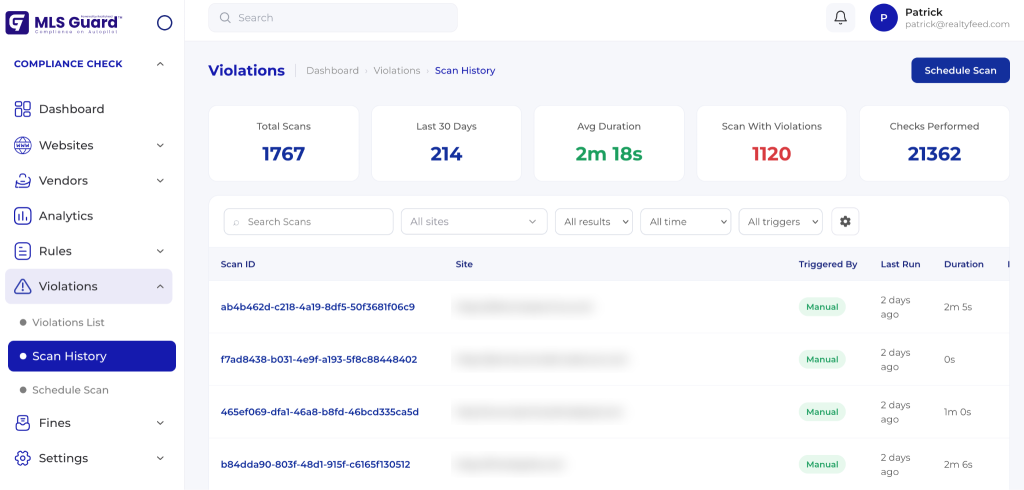
Every scan stores the result for each rule along with a snapshot of the page, hashed so changes can be detected from one scan to the next. Week after week, your organization builds a complete history of what every site displayed, which rules it passed or failed, and what action you took.
That history answers questions manual review never could. When did this site become non-compliant? How long was the violation live? Was it fixed and then reintroduced? Have similar violations been treated the same way across all participants?
When a participant disputes a fine, you have evidence rather than someone’s recollection. When your board asks whether enforcement is consistent, you can show them. When a compliance officer leaves your organization, their knowledge doesn’t leave with them. And if your practices are ever questioned, you can demonstrate a documented, rules-based process applied evenly to everyone.
2. Every site, every rule, on a schedule
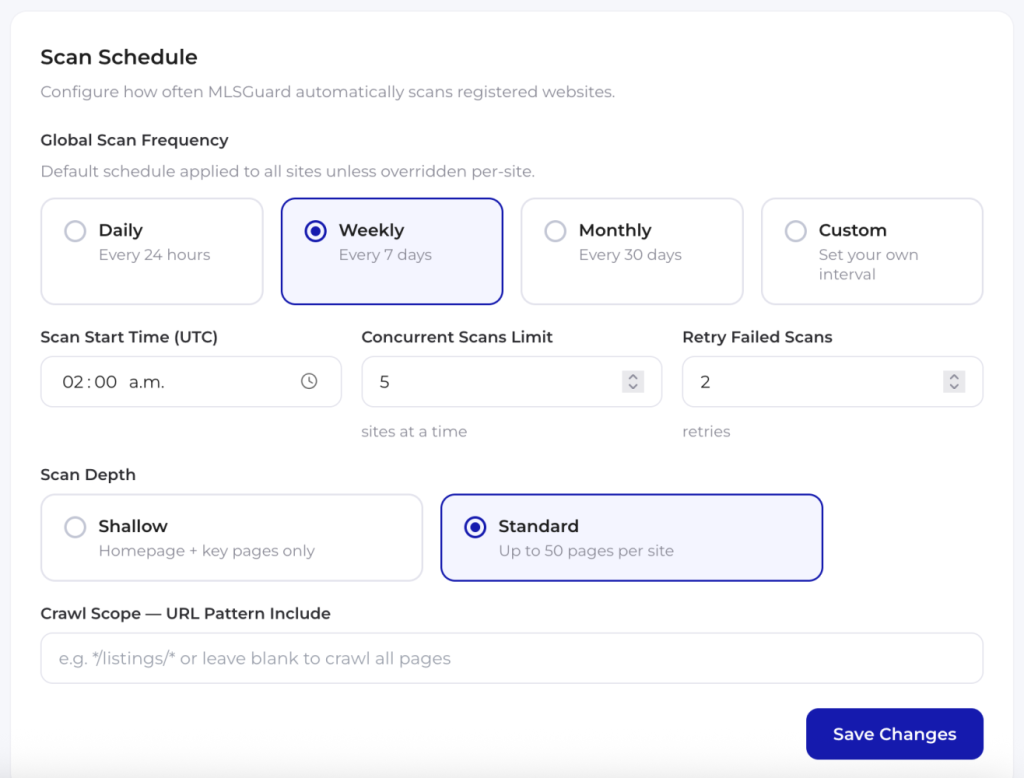
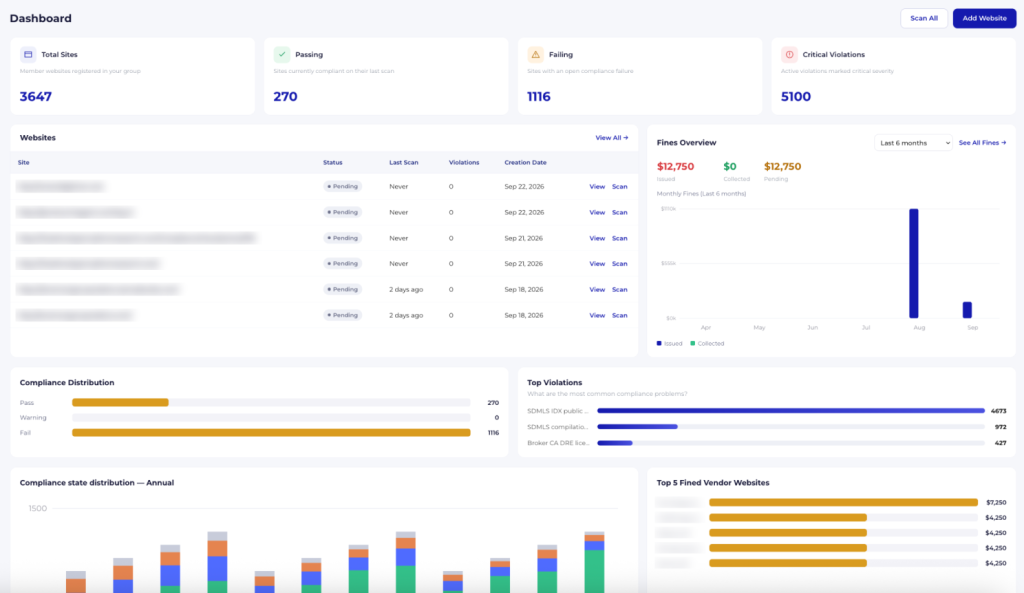
Reactive enforcement only catches what people complain about. Once a website is registered in MLS Guard™, an AI crawler visits it on a schedule you set and reads the page much the way a person would. For sites that are heavy on JavaScript, sit behind a login, or are simply unusual, a full browser engine steps in automatically. Both feed the same results store, so nothing slips through because a site was built in an odd way.
Instead of spot checking a handful of sites, you’re looking at your entire network, all the time.
3. Your rules, configured your way
Rules are configured per organization using 13 rule types covering the checks compliance teams run most often: required disclosures and prohibited phrases, required links and the pages they point to, logos and badges (verified with AI vision), data freshness, listing and photo limits, prohibited statuses and fields, expired open houses, and conditional field checks.
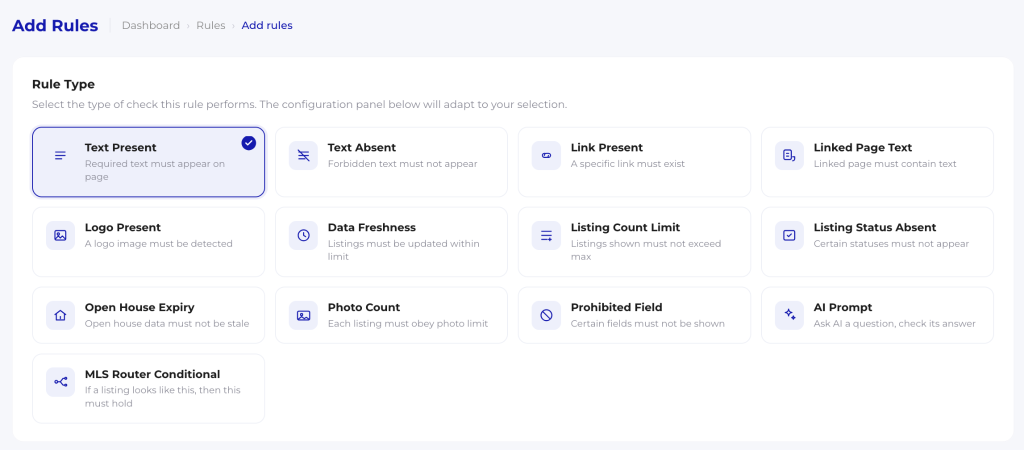
For anything else, the AI Prompt rule lets you describe a requirement in plain language and define the expected result. Grace periods let you roll out new requirements without catching participants off guard, and when your rules change, you update them in one place.
4. Enforcement that actually closes the loop
Plenty of tools can tell you there’s a problem. Far fewer help you act on it.
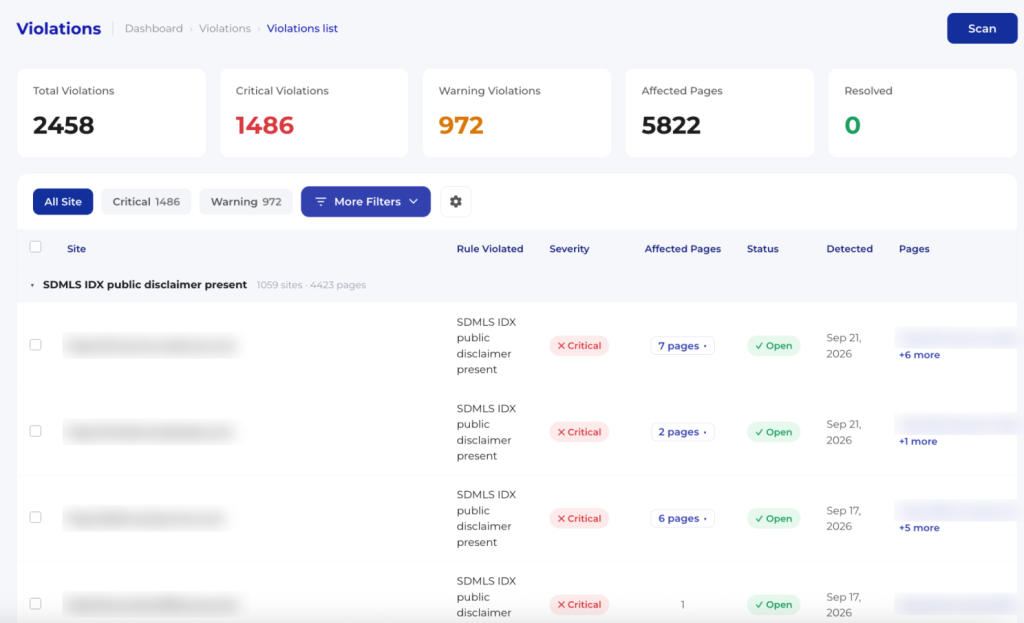
In MLS Guard™, a failed check becomes a tracked violation that staff can review before anything happens, so AI speeds up the work without removing human judgment. Confirmed violations can become fines, and when MLS Guard™ is connected to MLS Router™, those fines flow into invoicing automatically. Participants learn that rules carry real consequences, and fine revenue that used to be lost to administrative friction becomes something you can collect.
5. Coverage that grows without adding headcount
Scans run in parallel, and throughput can be increased as your coverage grows. AI costs are managed by design: the least expensive capable model handles each task, and premium vision models are used only when a check requires them. That keeps cost per scan predictable as you add sites.
For administrators, it means time back. MLS Guard™ also handles the communications, notifications, and reports that usually eat up a compliance team’s week, so there’s no juggling of inboxes, spreadsheets, and separate systems. Everything is managed from one dashboard showing open violations, compliance rates, and trends across the whole network, and your team can spend its energy on the cases that need a human.
Built for MLSs and associations, and for anyone monitoring a network of sites
MLSs and associations carry primary responsibility for display rule enforcement, so we designed MLS Guard™ with them in mind. But the problem isn’t unique to them. Brokerages need to know their agent websites meet requirements. Franchisors need consistent branding and disclosures across every office. IDX technology providers want to catch display issues on client sites before an MLS does. If you need an automated way to monitor compliance across a network of websites, MLS Guard™ was built for you.
Works with MLS Router™, or on its own
If you use MLS Router™ for data feed distribution, MLS Guard™ can sync with it to pull in website and contract information, keeping your monitored sites aligned with the feeds you’ve licensed. That connection is a convenience, not a requirement. MLS Guard™ works as a standalone product, whatever system you use for data distribution today.
See it on your own sites
MLS Guard™ is live and ready to deploy now. Book a demo and we’ll scan a sample of sites from your network and walk you through real findings. Your organization can then start with a pilot and expand once you see the results.
Compliance doesn’t have to mean chasing complaints. It can mean knowing where every site in your network stands, and having the history to prove it.
Sorry, the comment form is closed at this time.