

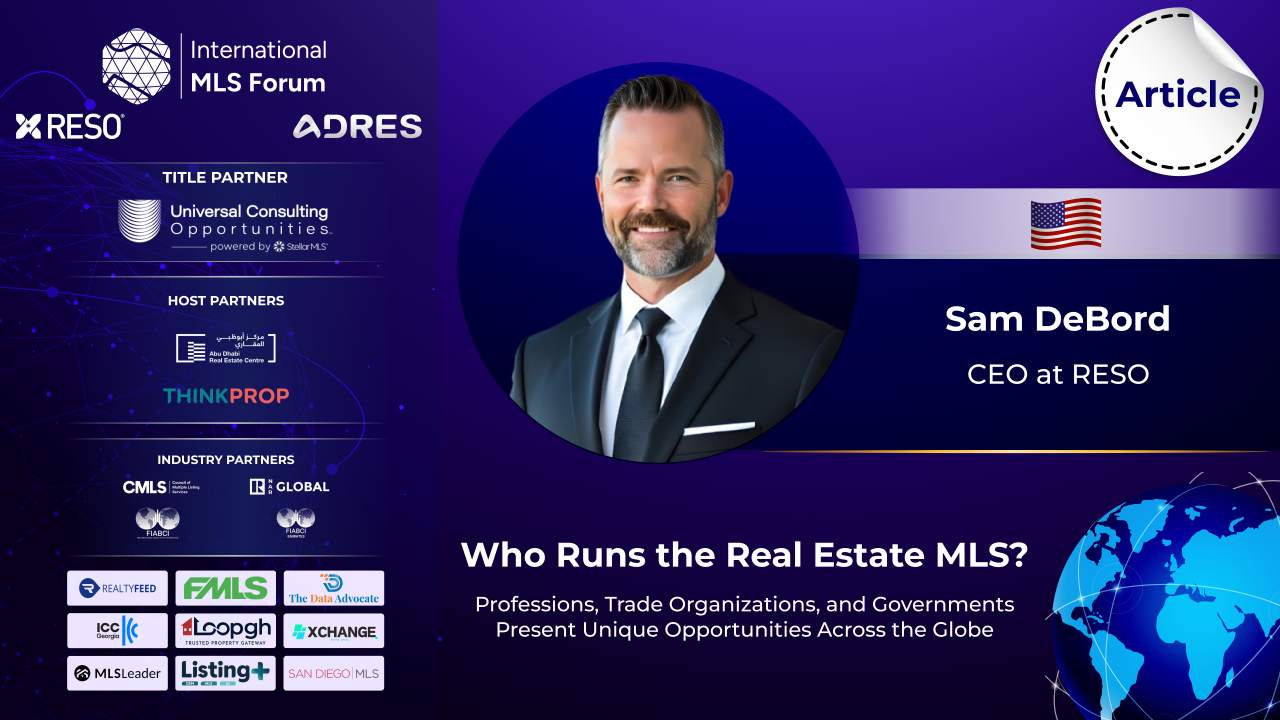
Who Runs the Real Estate MLS?

Professions, Trade Organizations, and Governments Present Unique Opportunities Across the Globe
By Sam DeBord CEO at Real Estate Standards Organization (RESO)
Multiple Listing Services in real estate have been foundational in creating transparent, liquid marketplaces that benefit consumers, professionals, and communities. They create maximum exposure to buyer demand for sellers, maximum access to housing opportunities for buyers, and maximum accurate real estate information–property data–to the wide range of stakeholders making real estate decisions across cities and countries.
What we’ve known in the first MLS markets across North America has been an MLS ecosystem built and maintained by brokers and their REALTOR associations. These self-regulated industry organizations have created their own rules, layered on top of the government-regulated rules that states and provinces create to license brokers and agents.
So the government’s role has always been an undercurrent of the MLS industry’s understood rule set in these North American MLS marketplaces. In global marketplaces, we’re seeing some innovative alternative models that bring government front and center in ensuring the MLS marketplace provides accuracy and transparency for home buyers and sellers through direct regulation of the multiple listing service.
I’ve had the privilege to do some work with government-related organizations in the United Arab Emirates. When we started, they were in the early planning phase for a government regulated, organized marketplace, with many features similar to a North American MLS. The organizations involved were the government agency for real estate strategy and regulation, as well as its public facing proptech development arm.
The Abu Dhabi Real Estate Centre – مركز أبوظبي العقاري Centre (ADREC) was supporting the creation of the Madhmoun MLS platform, a marketplace with international standards-based capabilities. And Advanced Real Estate Services (ADRES ), was implementing the service and training the marketplace’s brokers on how it would work. Madhmoun, which means “verified” in Arabic, is an innovative and unique service in the gulf region, and its goal is to have an information marketplace that’s trusted, efficient, and comprehensive.
The obstacles to creating a new MLS for the first time in a country are significant: The inertia of traditional private listing practices is always a hurdle, with private listings and unlicensed advertisers providing inaccurate information to potential buyers outside of the MLS. The lack of a broker with an exclusive agency arrangement with a seller makes listing brokers wary of broad exposure for their listings in many countries.
The obstacles for Abu Dhabi were multiple: brokers’ traditional incentives aligned with unregulated advertising and the inertia of ingrained practices. Unique leverage was needed. ADREC and ADRES created a strategy to apply it.
Some leverage comes from the power of persuasion. Other leverage comes from the explicit power of compulsion. Governments often mandate things that are viewed as good for the whole of the community.
This formalization of license law provided one source of strength for the initiative’s capabilities. The new technology tools and data set available within the Madhmoun platform was another strength to motivate movement toward the outcome Abu Dhabi was seeking. And it needed to use these levers to change incentives and behavior to manifest the robust, accurate real estate information marketplace that it sought to achieve.
Abu Dhabi’s government had the unique leverage to not only license brokers, but also to mandate broker business practices. So the government did what only governments can do: mandate that all listings and advertisements in Abu Dhabi must be registered and verified with its new platform.
Only properties with a valid Madhmoun permit issued via the government were eligible for listing and advertising. Property owners would identify their property and their broker in the system. Brokers were required to complete an authorization to stay compliant and retain MLS platform access.
The results were dramatic, and almost immediate. The decision to comply with the new rules was fairly straightforward for the brokers. To retain their licenses and sell property, they had to begin getting listing permits. 90,000 listings went from unregulated advertisements to Madhmoun-permitted listings in the span of two months.
The impact of Madhmoun has been both measurable and transformative. Listings visibility increased by 70%, listings accuracy increased from 50% to 95%, transaction timelines are noticeably accelerated. More importantly, the market has shifted from a fragmented, partially opaque environment to one where data accuracy, transparency, and trust are embedded by design. This has strengthened confidence among buyers, sellers, and investors – both locally and internationally – while improving overall market liquidity.
Critically, the platform aligned itself with international data standards so that it wouldn’t be just a service for its brokers domestically, but also allow property data to flow out and back with partner organizations across the globe. Madhmoun aligned itself with the GDX – Global Data Exchange, a peer-to-peer international real estate listing exchange. Based on the Real Estate Standards Organization (RESO) Web API and Data Dictionary standards, organizations across the globe are using the GDX to display their for sale properties to the rest of the world and to bring international buying opportunities to their own local communities. This positions Abu Dhabi not just as a participant in the global real estate ecosystem, but as an active contributor and emerging leader in cross-border data exchange.
Most importantly, the trust of sellers, buyers and investors, domestic and international, is greatly increased in this verified, transparent real estate marketplace. The market’s liquidity is greatly enhanced through the trusted set of rules that make its benefits possible.
Abu Dhabi’s Madhmoun model demonstrates that there is no single way to build an MLS, but there are powerful advantages to aligning regulation, technology, and data standards under a unified vision. By leveraging government authority, enabling market adoption through technology, and connecting to global standards, Abu Dhabi has created one of the most advanced and trusted real estate marketplaces in the region.
As the platform continues to evolve, its future extends beyond listings into areas such as , AI-driven property valuation and analytics, predictive market intelligence, integrated transaction workflows, and enhanced investor access and decision-making tools. These advancements will further strengthen the role of data as the backbone of real estate markets and reinforce Abu Dhabi’s position as a global benchmark for MLS innovation.
Of course, there are many markets around the world that would prefer to keep their MLS regulated by their industry, and the level of government involvement is always a local issue to be decided by the stakeholders in that region. But the effectiveness of the Madhmoun platform provides another unique insight for communities and countries investigating the creation of an MLS for the first time. There are many different ways to create leverage and ensure the accuracy of the marketplace. This level of government support provides another pathway that may be effective for another country seeking to create this housing marketplace that’s a benefit to all stakeholders in real estate transactions and data.
Notice:
The articles published on the International MLS Forum website and LinkedIn page are authored by renowned industry leaders, seasoned practitioners, and respected veterans of the global real estate sector. These perspectives reflect their own professional experiences and insights, and do not necessarily represent the official views or positions of the International MLS Forum organizers.
Our goal is to provide a platform that amplifies diverse thought leadership and fosters open dialogue on the future of MLS, proptech, and real estate practices worldwide.
Sorry, the comment form is closed at this time.